
Reflections for Holy Week:
Easter Sunday
By Jacob McRae
Easter Morning
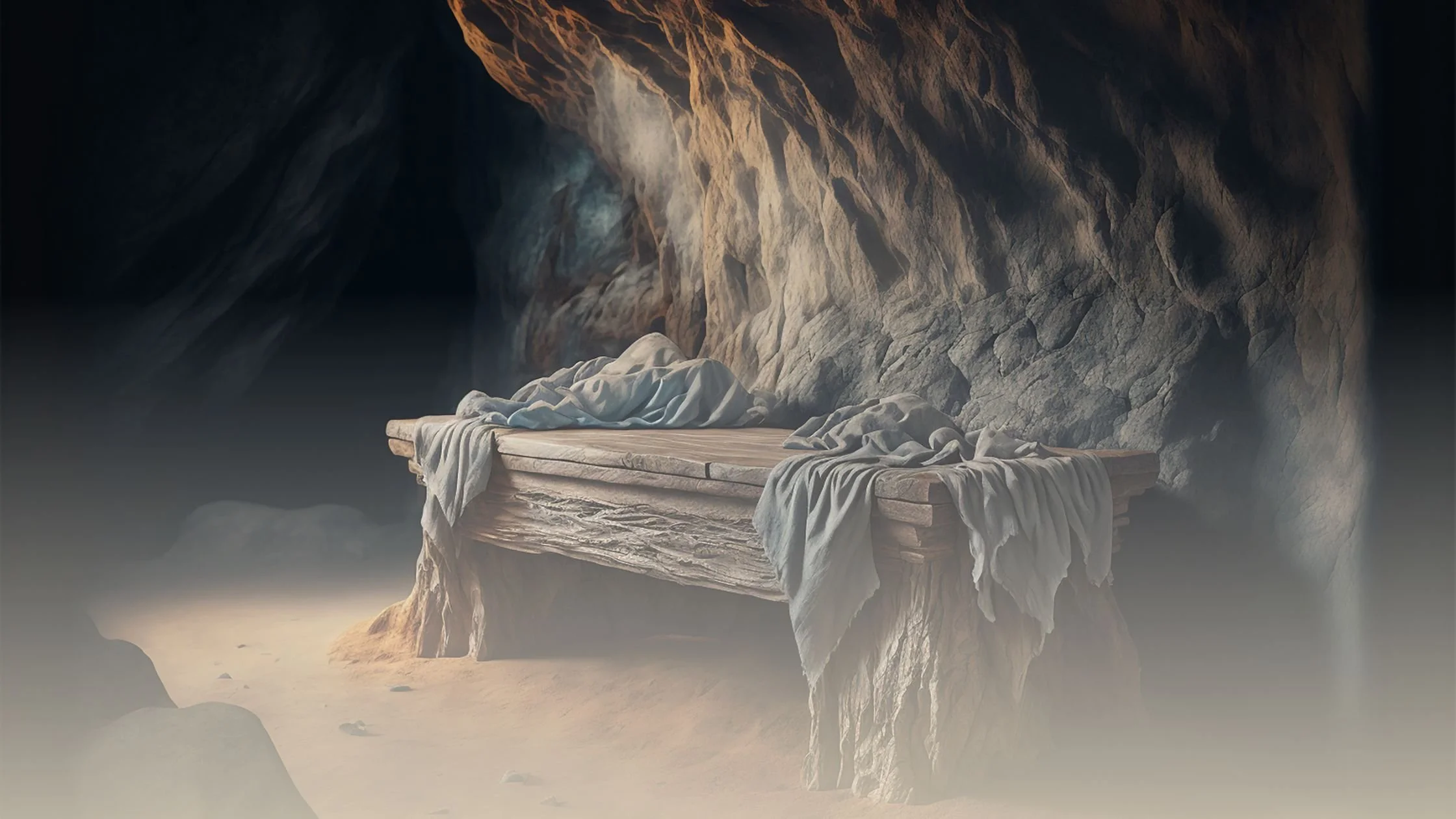
The Gospels tell us that early on the first day of the week, several women who were followers of Jesus came to the tomb where He was laid. The women came with spices, expecting to anoint a dead body--they came expecting grief or perhaps closure, but certainly, the quiet finality of death. Instead, they found the stone rolled away and the tomb empty. Luke records this incredible moment of grief becoming joy through the words of the angel who greets these surprised women:
“Why do you seek the living among the dead? He is not here, but has risen.”
(Luke 24:5-6)
And just like that, everything changed.
God’s Story and the Resurrection
The resurrection of Jesus was not simply the happy ending to an otherwise tragic story; rather, the entirety of the Biblical narrative points to this singular resurrection as the decisive moment in history where the promises of God find their fulfillment. And yet, even if the resurrection of Jesus eternally stands as the “Yes and Amen!” to all the hopes of God’s people, the resurrection is not in fact an ending to the story…but a whole new beginning.
Not long after the beginning of the Biblical narrative, death had cast its shadow over all of humanity. When sin first entered the world, God warned Adam:
“...for you are dust, and to dust you shall return.”
(Genesis 3:19)
Death was our future.
From that moment forward, death became the great enemy of God’s creation. Generation after generation, the repeating refrain of Scripture’s genealogies echo: “and he died…and he died…and he died…” (see, for example, Genesis 5). Yet even within that darkness, God had planted seeds of promise and redemption by declaring the inevitable end of the Serpent’s legacy (Gen. 3:15), and His plans to bring blessings to all the nations of the earth (Gen. 12:3). Centuries later, Isaiah the Prophet spoke of a day when death itself would be defeated and sorrows would cease to be:
“He will swallow up death forever; and the Lord GOD will wipe away tears from all faces.”
(Isaiah 25:8)
Easter morning is the moment when these promises begin to break into history. When Christ rose from the grave, death no longer held the inevitable final word over humanity. Again, the resurrection of Jesus was never merely about the resuscitation of one man; it was the beginning of a whole new creation. As Paul declared:
“But in fact Christ has been raised from the dead, the firstfruits of those who have fallen asleep.”
(1 Corinthians 15:20)
The language Paul uses of firstfruits is important. In the seasons of Israel’s agricultural harvest, the “firstfruits” were a sign of hope; a promise that guaranteed that this initial yield was only the beginning of the harvest, and that much more was to come. Likewise, the resurrection of Jesus is the first harvest of so much more--a coming resurrection for all who belong to Him.
Earlier in Holy Week, we reflected on the paradox of the cross: that life is found through death, that victory comes through sacrifice, and that discipleship takes the shape of the cross. Easter does not remove that paradox but further reveals its purpose in us. Just as the cross was never the end of Jesus’ story, neither will the pains of this world, or death, be the end of ours. As Paul reminds the Corinthians:
“Death is swallowed up in victory.
O death, where is your victory?
O death, where is your sting?”
(1 Corinthians 15:54–55)
Because Christ lives, the path of the cross is no longer a road toward destruction, but the road that leads to resurrection and life. This is why Christians throughout history have been able to face suffering, sacrifice, and even death with hope. We follow a risen Lord, and our lives are now hidden in Him (Col. 3:3).
New Creation and the Power of Being “In Christ”
Throughout the New Testament, one of the ideas that appears again and again to describe the identity of believers, is their participation “in Christ” (see Ephesians 1:3-14). To be a Christian, then, is not to be one who simply admires Jesus or generally agrees with His teachings; rather, the gospel announces that something far more radical has taken place for those who are “in Christ” by grace, through faith. New Testament scholar Constantine Campbell identifies four main categories for describing exactly what it means to be “in Christ” (descriptions of each category are my own).
Union - Through God’s redemption and the forgiveness of sins, Christ has purposed to unite all things in Him, removing all dividing walls of hostility and separation, and reconciling the believer to God through the cross.
Participation - Believers have been made alive with Christ, raised with Christ, and seated with Christ in the heavenly realms. By faith, believers participate in the events of Christ’s narrative--being pulled through his death, resurrection, and ascension.
Identification - By participating with Christ, believers have been adopted as heirs with Christ, sealed with a promised and eternal inheritance. Estranged orphans have become beloved children of God.
Incorporation - Believers are now being built into a living temple, and are part of one body--Christ’s body. Individual union with Christ also means corporate unification to one another, with each “body part” having a Spirit-empowered role to play.
“Therefore, if anyone is in Christ, he is a new creation.
The old has passed away; behold, the new has come.”
(2 Corinthians 5:17)
The unbelievable implication of “union with Christ” is that what is true of Him becomes true of us. His story becomes our story. The resurrection is not only something that happened to Jesus, it is something that begins to happen within us, His people. Paul speaks further to this mystery in Romans:
“We were buried therefore with him by baptism into death, in order that, just as Christ was raised from the dead by the glory of the Father, we too might walk in newness of life.”
(Romans 6:4)
— Excerpts from Paul and Union with Christ: An Exegetical and Theological Study by Constantine Campbell
Resurrection Life Now
Because we are united to the risen Christ, the power of the resurrection is not only a future hope, although the Scriptures do promise the physical resurrection of our bodies; instead, resurrection life is also a present reality. To participate in the resurrection of Jesus is to experience the transformation from death to life, and the resurrection power of Christ transforms how we live now. In other words, where sin once enslaved us, new Spirit-enabled freedom becomes possible. Where shame once defined us, forgiveness declares adoption and a new identity: Children of God (Gal. 3:26-27). Where the fear of death and eternal consequences of sin once held humanity captive as slaves, hope in salvation becomes our firm foundation. Again, Paul writes elsewhere:
“If the Spirit of him who raised Jesus from the dead dwells in you, he who raised Christ Jesus from the dead will also give life to your mortal bodies through his Spirit who dwells in you.”
(Romans 8:11)
The same Spirit who raised Christ from the dark tomb now dwells within believers. Because of this, the Christian life is not simply an effort to imitate Jesus through the strength of our own will-power; rather, it is participation in the very life of Christ.
Living as Resurrection People
Easter, then, invites us to see our lives differently. If Christ is risen, then the old world defined by sin, fear, and death is already passing away and a new creation has begun. This idea of “new creation” is not only referring to the promise of a New Earth upon Christ’s return (Isa. 66:22; Rev. 21:1) --but to the right now reality of anyone who has put their faith in Christ.
Paul writes:
“Therefore, if anyone is in Christ, he is a new creation. The old has passed away; behold, the new has come”
(2 Cor. 5:17)
This means that our participation in Christ (a gift of grace through faith) demands a response from our lives and the way we walk. Again, Paul instructs us:
“If then you have been raised with Christ, seek the things that are above, where Christ is.”
(Col. 3:1)
And,
“...assuming that you have heard about him [Jesus] and were taught in him, as the truth is in Jesus, to put off your old self, which belongs to your former manner of life and is corrupt through deceitful desires, and to be renewed in the spirit of your minds, and to put on the new self, created after the likeness of God in true righteousness and holiness.”
(Eph. 4:20-24)
In terms of “putting on the new self” and living as “new creations,” Paul understands that our identity and our experiences are not the same thing. Despite being “new creations,” and the eternal change in identity that comes through our participation in Christ, transformation is a lifelong process. Although the “old self” may continue to rear its ugly head through our decisions--our status before God remains forever changed (we are new creations in Christ), even though our habits, instincts, and patterns of living are still in the process of being retrained. Resurrection life is a gift to be lived into daily as we are transformed by degrees into Christ’s likeness (2 Cor. 3:18).
The Beginning of the New Creation
The final chapters of Scripture tell us where the resurrection story ultimately leads. One day, the risen Christ will return, and the work that began on Easter morning will reach its completion. John describes that glorious day in this way:
“Then I saw a new heaven and a new earth, for the first heaven and the first earth had passed away… And I heard a loud voice from the throne saying, “Behold, the dwelling place of God is with man. He will dwell with them, and they will be his people, and God himself will be with them as their God. He will wipe away every tear from their eyes, and death shall be no more, neither shall there be mourning, nor crying, nor pain anymore, for the former things have passed away.” And he who was seated on the throne said, “Behold, I am making all things new.”
(Rev. 21:1-5)
The resurrection of Jesus is the first glimpse of that future and the dawn of a new world breaking into the old one. It is the moment where death’s finality lost its grip and where sin’s power was forever broken. It is the firstruits of God’s promise to restore all things, telling of an abundant harvest yet to come. The beauty of Easter lays in the promise it holds: that because we are in Christ, that future already belongs to us. Alleluia. Christ is Risen!
“I will not leave you as orphans; I will come to you…Because I live, you also will live.”
(John 14:18-19)
To learn more about Jacob and his family follow his blog: https://jacobandsamantha.org/